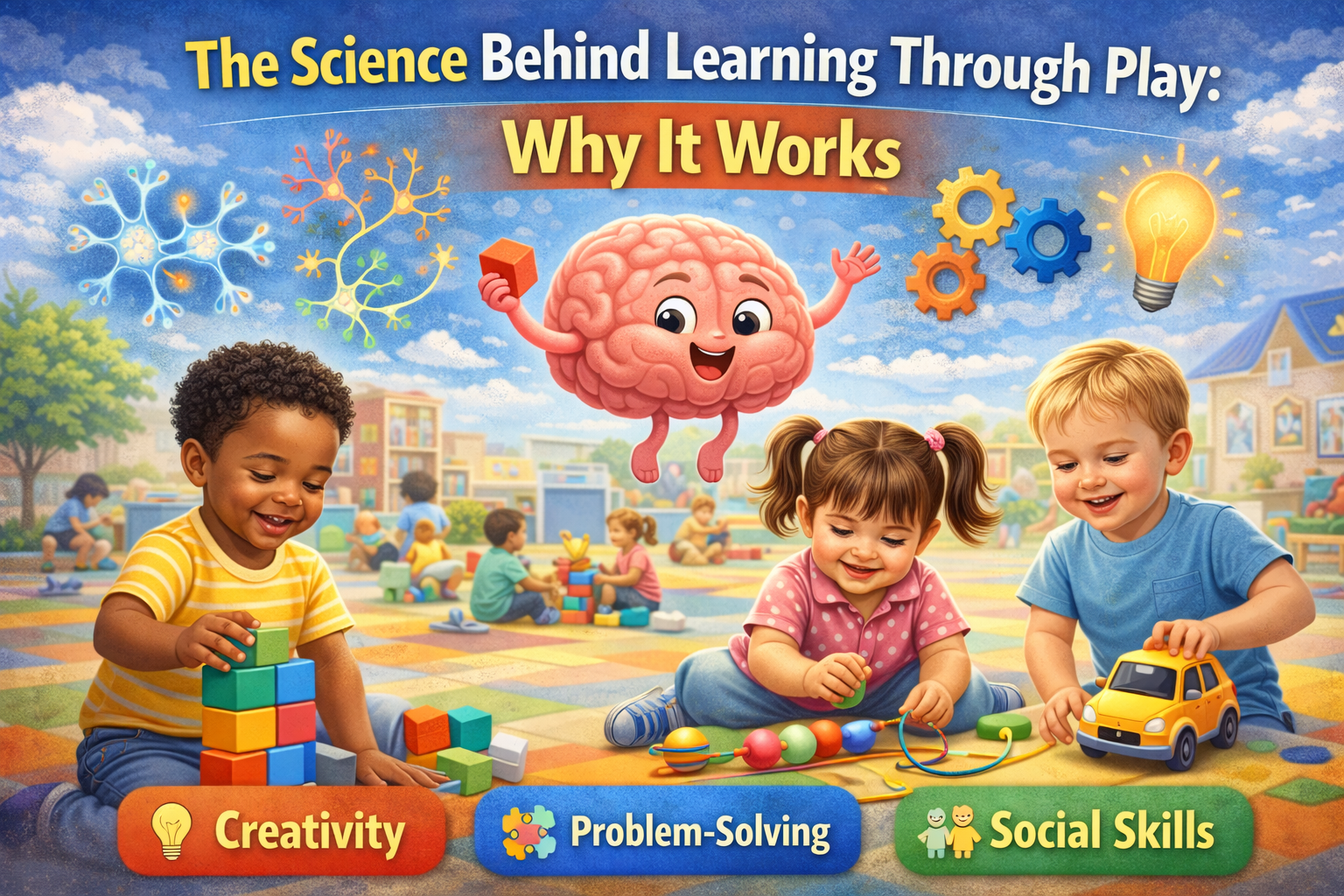
Play is often misunderstood as a break from learning—but science tells a very different story. For young children, play is one of the most powerful learning mechanisms available. Decades of research in neuroscience, psychology, and early childhood education confirm that learning through play is not only effective, but essential for healthy brain development.
Rather than passive instruction, play-based education engages the whole child—mind, body, and emotions. It supports curiosity, creativity, problem-solving, and social interaction while strengthening the brain systems that children rely on for lifelong learning.
This article takes a deep dive into the science behind learning through play, explaining why it works so well and why it should be a cornerstone of every high-quality childcare curriculum.
What Is Learning Through Play?
Learning through play is an educational approach where children acquire knowledge and skills through active, hands-on, and meaningful experiences. Instead of memorizing information, children explore concepts through movement, imagination, experimentation, and interaction.
In play-based learning environments, children:
- Choose activities that interest them
- Explore materials freely
- Ask questions and test ideas
- Learn through trial and error
- Engage socially with peers
Educators guide play with intention, aligning activities with developmental goals while preserving children’s natural motivation to learn.
How the Brain Learns Best in Early Childhood
Early childhood is a period of rapid brain growth. During the first five years of life, billions of neural connections are formed based on experience. The brain strengthens connections that are used frequently and prunes those that are not.
Science shows that the brain learns best when experiences are:
- Active rather than passive
- Emotionally engaging
- Socially interactive
- Repetitive and meaningful
Play naturally meets all of these conditions, making it one of the most efficient learning tools for young children.
The Neuroscience of Play-Based Learning
- Play Strengthens Neural Connections
When children play, multiple areas of the brain activate simultaneously. For example:
- Building blocks engages motor planning, spatial reasoning, and problem-solving
- Pretend play activates language, memory, and emotional processing
- Physical play stimulates balance, coordination, and executive function
These combined experiences strengthen neural pathways, making learning deeper and more durable. This is a core principle of early development science.
- Play Supports Executive Function Development
Executive functions are the brain’s control systems responsible for:
- Attention
- Memory
- Self-regulation
- Flexible thinking
Play-based activities naturally develop these skills. When children plan a game, follow rules, adapt to changes, or negotiate roles, they are practicing executive function in real time.
Strong executive function is one of the best predictors of long-term academic and life success.
The Role of Emotion in Learning
- Emotion Drives Memory and Understanding
The brain remembers information better when it is tied to emotion. Play is joyful, motivating, and meaningful—making it an ideal learning context.
Positive emotional experiences during play:
- Increase dopamine levels (linked to motivation and learning)
- Strengthen memory formation
- Reduce stress that interferes with learning
This is why children remember what they learn through play far better than what they memorize through repetition alone.
Why Play Encourages Deeper Learning
- Play Promotes Active Engagement
Traditional instruction often requires children to sit still and absorb information. In contrast, play demands participation.
Through play, children:
- Test ideas
- Make predictions
- Observe outcomes
- Adjust their thinking
This active engagement leads to deeper understanding and stronger problem-solving skills—key goals of any effective childcare curriculum.
- Play Encourages Curiosity and Exploration
Curiosity is the engine of learning. Play allows children to follow their interests and explore questions at their own pace.
This self-directed exploration:
- Builds intrinsic motivation
- Encourages persistence
- Supports independent thinking
From a scientific perspective, curiosity-driven learning leads to stronger neural engagement and long-term retention.
Learning Through Play and Cognitive Development
- Builds Problem-Solving and Critical Thinking Skills
Play presents natural challenges: a tower falls, a puzzle doesn’t fit, a game needs new rules.
These moments teach children to:
- Analyze problems
- Try different strategies
- Learn from mistakes
- Think creatively
Problem-solving developed through play forms the foundation for math, science, and logical reasoning later in life.
- Supports Language and Communication Development
Play-based environments are rich in language. Children talk, negotiate, explain, and imagine.
Through play, children:
- Expand vocabulary
- Practice sentence structure
- Learn conversational turn-taking
- Strengthen listening skills
Language learned in play contexts is meaningful and functional, making it easier for children to apply communication skills in real situations.
Social Learning and Brain Development
- Play Builds Social and Emotional Intelligence
Human brains are wired for social learning. Play offers constant opportunities for interaction.
Children learn to:
- Cooperate with peers
- Understand others’ perspectives
- Manage emotions
- Resolve conflicts
These social experiences strengthen emotional regulation and empathy—skills deeply connected to brain development and long-term well-being.
The Science of Physical Play and Learning
- Movement Enhances Brain Function
Research shows that physical movement increases blood flow to the brain and improves cognitive performance.
Physical play supports:
- Memory
- Attention
- Mood regulation
- Learning readiness
This connection explains why children learn better when they are allowed to move rather than remain sedentary for long periods.
Play Reduces Stress and Improves Learning Capacity
- Stress Inhibits Learning—Play Reduces It
High stress levels interfere with memory, attention, and emotional regulation. Play acts as a natural stress reliever.
Play-based learning:
- Lowers cortisol levels
- Encourages emotional expression
- Creates a sense of safety and control
When children feel safe and relaxed, their brains are more open to learning.
Learning Through Play vs. Rote Instruction
Traditional rote learning emphasizes memorization and repetition. While this approach may work for older learners, it is poorly aligned with how young children’s brains develop.
Play-based education:
- Matches developmental needs
- Encourages exploration rather than compliance
- Builds understanding instead of memorization
Early development science consistently shows that children who learn through play develop stronger foundational skills than those exposed to early academic pressure.
How Play-Based Childcare Curriculums Are Designed
High-quality childcare curriculums integrate play with learning objectives.
Effective play-based programs:
- Set clear developmental goals
- Use guided play to support learning
- Observe and adapt to children’s interests
- Balance structure with freedom
This intentional design ensures children are learning deeply while remaining engaged and motivated.
Long-Term Benefits of Learning Through Play
Research links play-based early education with:
- Better school readiness
- Stronger executive function
- Higher social competence
- Improved emotional regulation
- Greater love of learning
These benefits extend well beyond early childhood, supporting success in school and adulthood.
Addressing Common Myths About Play-Based Learning
Myth: Play is unstructured and lacks purpose
Reality: High-quality play-based learning is intentional and developmentally aligned
Myth: Play delays academic learning
Reality: Play builds the foundational skills academics depend on
Science consistently supports play as a serious and effective learning strategy.
Why Learning Through Play Is Backed by Science
From brain development to emotional regulation, the evidence is clear: learning through play aligns perfectly with how young children grow and learn. It supports cognitive, social, emotional, and physical development simultaneously—something no single worksheet or lecture can achieve.
Play is not a break from learning.
Play is how learning begins.
Final Thoughts: Play Is the Brain’s Natural Learning System
The science behind learning through play reveals a simple truth: children learn best when they are active, engaged, curious, and emotionally connected. Play-based education respects how young brains develop and provides the experiences needed to build strong foundations for lifelong learning.
When childcare curriculums prioritize play, they are not lowering standards—they are aligning education with science. And when education aligns with science, children thrive.